Informal Ministerial Meeting of Council of Baltic Sea States, EU and Ukraine
Foreign ministers from the Baltic Sea Region, joined by the EU’s Kaja Kallas and Ukraine’s Andrii Sybiha, met in Warsaw to discuss Europe’s role in potential peace talks, continued support for Ukraine and responses to Russia’s hybrid activities.
Originally published by the Ministry of Foreign Affairs Republic of Poland.
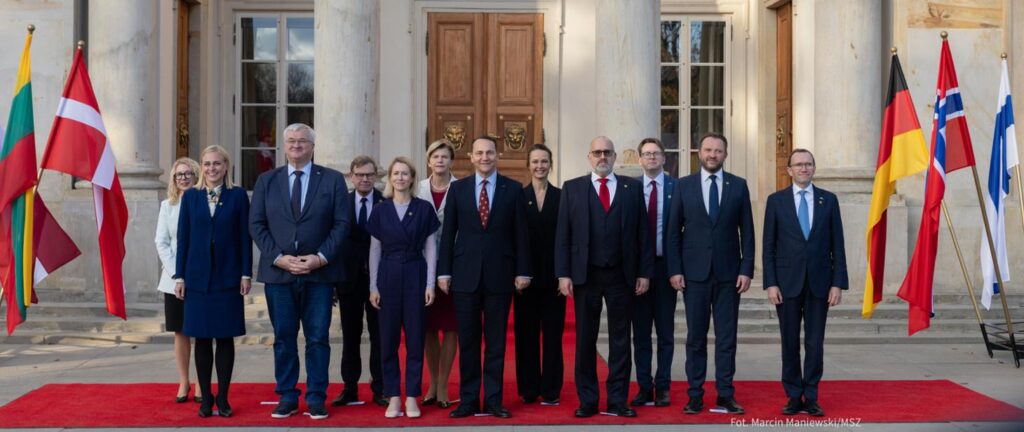
Potential engagement of the Council of the Baltic Sea States in peace talks between Russia and Ukraine and the methods of responding to Russia’s hybrid activities targeting the countries in the region were the focus of an informal meeting of the foreign ministers of the Council of the Baltic Sea States [in Warsaw on Friday, 6 November 2026].
High Representative of the Union for Foreign Affairs and Security Policy Kaja Kallas and Ukraine’s Minister of Foreign Affairs Andrii Sybiha also took part in the gathering.
After the informal ministerial of the Council of the Baltic Sea States and Ukraine, the foreign ministers issued a joint statement specifying the measures that help stop the Russian aggression against Ukraine and Russian hybrid activities targeting European countries.
Held in Warsaw on 6 November, the meeting was organised jointly with the Icelandic Presidency of the Council of the Baltic Sea States. Deputy Prime Minister and Minister of Foreign Affairs Radosław Sikorski invited the Council’s foreign ministers, High Representative of the Union for Foreign Affairs and Security Policy Kaja Kallas, and Ukraine’s Minister of Foreign Affairs Andrii Sybiha to take part in the meeting in Poland. The participants pointed out that further support for Ukraine is necessary in the face of Russian air strikes against Ukraine’s critical infrastructure.
NATO’s eastern flank on European security
The ministers confirmed that Europe should play a meaningful role in the peace negotiation process. The talks emphasised that the matters concerning Europe’s fundamental security interests require the presence of the eastern flank’s representatives at the table.
Minister Sikorski observed that the meeting confirmed the region countries’ unity in the face of the Russian aggression and readiness to enhance military and financial support for Ukraine.
It is essential to maintain the proper sequence. This message has resounded clearly in today’s talks. Namely, first there must be a ceasefire, then talks on a lasting peace, and only after that, potential discussions on how to restore the functioning of the European security architecture, and, perhaps, how to reinstate arms control regimes.
The EU’s top diplomat, Kaja Kallas, said:
Putin does not have a veto over European security. Any agreement to end the war must prevent Russia from re-arming and re-attacking. […] Concessions should be on the aggressor, not on the victim.
Ukraine’s foreign minister, Andrii Sybiha, added:
Russia is not and cannot be a guarantor of European security. Europe’s security formula means reliable protection from Russia, not discussion with Russia about spheres of influence. There will be no second Yalta or Munich.
Response to Russian hybrid pressure
The diplomats found it necessary to respond effectively to Russian hybrid pressure, in particular through resolute sanctions policy, including continued restrictions on the clunker fleet and imposing sanctions on its operators, additional visa restrictions, and opposition to Russia’s participation in sporting and cultural events.
The participants also agreed that it is legitimate to seek ways to use frozen Russian assets as a source of financing Ukraine’s defence and recovery.
Deterrence is not provocation
Minister Sikorski said that strengthening deterrence capabilities is not intended to provoke Russia. The Kremlin should understand that further aggression will only imply growing costs and consequences.
Poland supports Ukraine
Poland’s top diplomat reaffirmed Poland’s readiness as the leading country on the eastern flank to take part in the potential peace process. He also presented the scale of Warsaw’ support for Ukraine to date, in particular in terms of air defence and energy supplies.
The priority is to support Ukraine in preparing for the coming winter and to strengthen the resilience of its energy sector. Poland will allocate additional PLN 8 million to the Energy Community. These funds will be used to purchase generators for Ukraine.
Minister Radosław Sikorski said.
The total value of Poland’s military donations to Ukraine amounts to nearly EUR 4 billion (2022–2026). In January, when nearly 60% of Kyiv residents were without electricity, Poland immediately decided to deliver equipment to Ukraine—the Governmental Strategic Reserves Agency released 379 power generators and 18 heaters from its reserves. The City of Warsaw donated 90 generators. On top of that, those measures were supplemented with Polish citizens’ grassroots initiatives, such as the “Heat from Poland to Kyiv” campaign.
Minister Sikorski also noted the importance of the multinational military training exercise carried out in Poland by the Coalition of the Willing with the involvement of nearly two thousand Polish soldiers. Its aim is to demonstrate Europeans’ readiness to continue supporting Ukraine and to play a major role during the postwar period.
The Council of the Baltic Sea States (CBSS) was established in 1992 with Poland as one of its founders. The current presidency of the CBSS is held by Iceland. At present, the members include Denmark, Estonia, Finland, Germany, Iceland, Latvia, Lithuania, Norway, Poland, Sweden, and the EU. The Council focuses on supporting political dialogue and cooperation, setting strategic priorities and guiding regional initiatives in line with the organisation’s long-term priorities, namely Regional Identity, Sustainable and Prosperous Region, and Safe and Secure Region. At present, the Council of the Baltic Sea States runs four main bodies: the Expert Group on Sustainable Maritime Economy, the Task Force Against Trafficking in Human Beings, the Expert Group on Children at Risk, and the Civil Protection Network.
- Read the joint Ministerial statement (on the website of Ministry of Foreign Affairs Republic of Poland)
- Watch the press conference with Deputy Prime Minister and Minister of Foreign Affairs Radosław Sikorski, High Representative of the Union for Foreign Affairs and Security Policy Kaja Kallas, and Ukraine’s Minister of Foreign Affairs Andrii Sybiha